
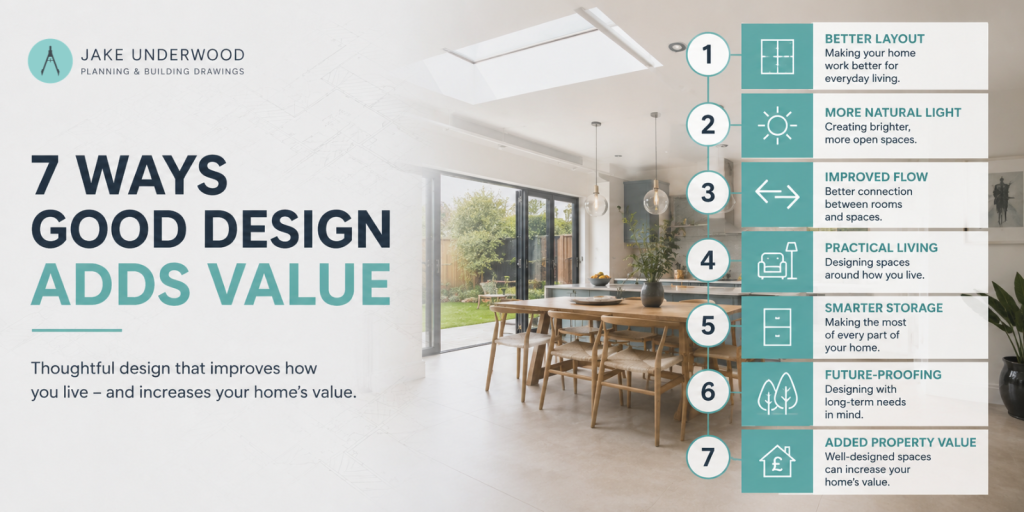
Seven ways good design adds real value to your home
When most people think about adding value to their property, they think about square footage. More rooms, more space, a bigger kitchen. And square footage matters — but it’s only part of the picture. Some of the most significant improvements to how a home feels and functions, and to what it’s worth on the open market, come not from adding space but from making better use of what’s already there.
Good design isn’t decoration. It’s problem-solving. A well-designed home works better for the people living in it every single day — and that practical quality is exactly what buyers recognise and pay for when the time comes to sell. Here are seven ways thoughtful design delivers value that goes well beyond how things look.
- A layout that works for how you actually live
Most homes weren’t designed for the way families live today. The separated reception rooms of a Victorian terrace, the galley kitchen of a 1970s semi, the awkward circulation of a house that’s been extended piecemeal over the decades — these layouts made sense at some point, but they can quietly erode the quality of daily life for years before anyone decides to do something about it.
Rethinking the layout is often the highest-value design decision available. Opening up the ground floor to create a kitchen and dining space that connects to the garden. Moving a bathroom to where it’s actually needed rather than where it happened to end up. Reconfiguring the first floor so the bedroom sizes reflect the reality of who uses them. These changes cost money, but the improvement to how the home functions — and how it feels — is immediate and lasting.
- More natural light
Light is one of the most powerful variables in how a home feels, and it’s one that design can influence significantly. A dark house feels smaller, colder, and less welcoming than a light one of identical size. A well-lit house feels generous even when it isn’t large.
Rear extensions with wide glazed openings, rooflights over kitchen extensions, borrowed light through internal glazed screens — these are all design tools that bring natural light deeper into the plan and change the character of a home fundamentally. In many properties across Surrey and Hampshire, the rear of the house receives good afternoon and evening sun that the existing layout simply doesn’t capture. Good design captures it.
- Improved flow between spaces
Flow is one of those qualities that’s easier to feel than to describe. A home with good flow is one where you move through it naturally, where spaces connect in a way that makes sense, where there’s no awkward threshold between the kitchen and the place where the family actually spends its time.
Poor flow is usually a legacy of how a house was originally built or has been modified over the years — a door in the wrong place, a corridor that eats into a room, a transition between old and new that was never properly resolved. Addressing flow is often a matter of relatively modest interventions — removing a wall, repositioning a door opening, redesigning the connection between an extension and the existing house — but the effect on how the home feels can be disproportionately large.
- Practical living — designing around real life
There’s a meaningful difference between a house that looks good in photographs and one that works well to live in. The two aren’t mutually exclusive, but they require different priorities at the design stage. A kitchen island that’s the right height and the right size for the family that uses it. A utility room positioned where wet coats and muddy boots actually arrive. A bathroom that two people can use simultaneously without getting in each other’s way.
These details don’t make magazine covers. They make daily life noticeably better, and they’re the things that people who’ve lived in a well-designed home find hardest to give up when they move somewhere less considered.
- Smarter storage
Storage is chronically underdesigned in most homes. The instinct is to treat it as an afterthought — a cupboard here, a wardrobe there — rather than as an integral part of the design that deserves the same attention as any other element.
Homes with good storage feel calm. Surfaces stay clear, rooms feel larger, and the low-level visual noise of accumulated clutter disappears. Built-in storage under stairs, deep drawer units in kitchens, niches in bathrooms, eaves storage in loft conversions — these are all opportunities to make the home work harder without adding square footage. In properties across Weybridge, Chertsey, and Addlestone where space is at a premium, intelligent storage design can make a significant difference to how spacious a home feels.
- Future-proofing
A well-designed home is one that works not just for the family’s current needs but for how those needs will evolve. Children grow up. Working patterns change. Elderly relatives may eventually need to be accommodated. A ground floor room that works as a study now and a bedroom later. A bathroom positioned to serve a potential annexe. Structural provisions made during an extension that allow for a future addition without starting from scratch.
Future-proofing isn’t about designing for every possible eventuality — it’s about avoiding decisions that unnecessarily close options off. The cost of thinking ahead at the design stage is negligible. The cost of undoing a decision that didn’t account for the future can be substantial.
- Added property value
All of the above translates, in the end, to a property that is worth more. Not just in the narrow sense of additional square footage — though that matters — but in the broader sense of a home that buyers recognise as well-considered, well-maintained, and genuinely pleasant to live in.
Estate agents across Surrey and Hampshire consistently report that well-designed extensions and conversions achieve stronger premiums than poorly designed ones of the same size. A rear extension that improves the layout and brings in natural light adds more value than one that simply appends a room to the back of the house without addressing how the home flows. The quality of the design — the decisions made at the drawing stage — is what the market reflects.
FAQ
Does a well-designed extension add more value than a basic one of the same size?
Yes, consistently. The quality of the design — how the new space connects to the existing house, how it handles light and flow, how well it’s been thought through — is reflected in how buyers perceive and value the property. A larger but poorly integrated extension can actually make a home harder to sell if it disrupts the layout or feels at odds with the rest of the house.
Which home improvements add the most value in Surrey?
Extensions that add a bedroom or meaningfully improve the ground floor living arrangement tend to deliver the strongest returns in the Surrey market. Loft conversions adding a bedroom and bathroom, and rear extensions that open up a kitchen-dining space to the garden, are consistently among the highest-value projects relative to their cost. The design quality — not just the square footage — is what determines where in the value range the finished project lands.
How do I know if my home has potential for improvement?
Most homes do, and the potential isn’t always obvious without a design eye. The best starting point is a conversation with a designer who can look at the existing layout and identify where the opportunities are — whether that’s in the footprint, the roof space, or simply in rearranging what’s already there. We offer exactly that kind of early conversation for homeowners across Surrey, Hampshire, Berkshire, and London, without any obligation to proceed further.
Want to explore what’s possible with your home?
Whether you’re thinking about an extension, a loft conversion, or simply want to understand what good design could do for the home you already have, we’d be happy to talk it through. We work with homeowners across Surrey, Hampshire, Berkshire, and London — taking projects from initial ideas through to planning permission and build-ready drawings.
Get in touch at jakeunderwood.com to start the conversation.
